
 Español
 العربية
 Francés
 Русский
 Português
 Deutsch
 Italiano
 Polski
 Malay
Malay
 日本語
日本語
 한국어
한국어
 Nederlands
 Indonesia
 български
 Українська
 فارسی
فارسی
 اوردو
اوردو
 тоҷикӣ
 বাংলা
বাংলা






Commercial Mower Fleet Planning: Deck Mix, Capacity & Triggers
Commercial mower fleet management starts with the work portfolio, not a preferred model. A profitable fleet matches deck sizes, transport and backup capacity to recurring routes. This guide provides a planning method for landscaping companies; it does not recommend one mower for every property or cover dealer stocking strategy.
On This Page
Plan the route before the machine
Commercial mower fleet management starts with the work portfolio, not a preferred model. A profitable fleet matches deck sizes, transport and backup capacity to recurring routes. This guide provides a planning method for landscaping companies; it does not recommend one mower for every property or cover dealer stocking strategy.
Segment the property portfolio
Group work by open acreage, obstacle density, gate width, slope and ground sensitivity, finish expectations, travel distance and service window. Record seasonal growth and whether crews return for trimming. A machine that is productive on an open campus can be inefficient on gated residential work even when both contracts have the same acreage.
Assign deck-size roles
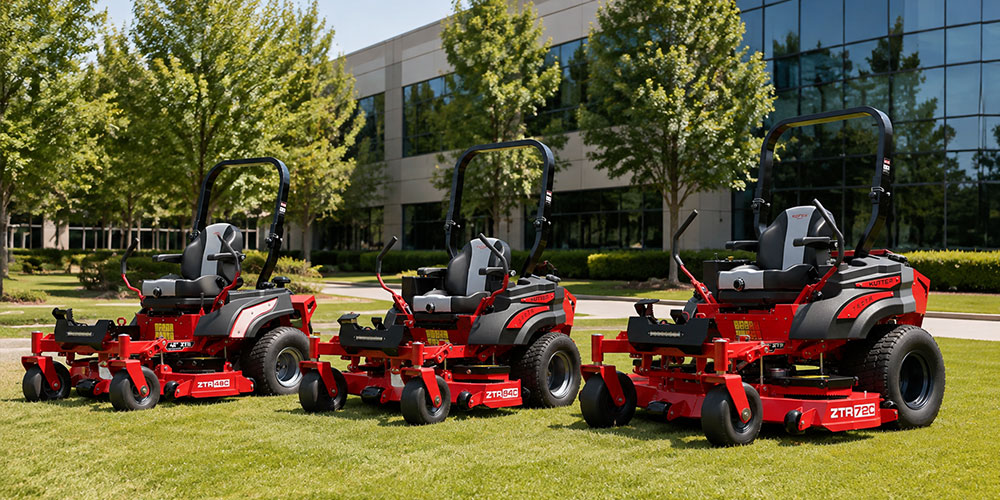
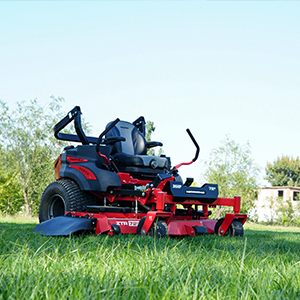
Use smaller decks for constrained access and detail work, mid-size decks as flexible route machines, and wide decks for open acreage. A mixed fleet often reduces route compromises. For example, review a ZTR-48C product page for narrow-access roles and a ZTR-54C product page for a main-route role. Validate actual dimensions before allocation.
Model route capacity
Estimate productive mowing time separately from driving, loading, fueling, breaks and trimming. Use observed field efficiency rather than theoretical deck-width output. Track acres or square meters per productive hour by property type, then compare planned workload with available machine-hours during the peak week.
Worked example: A 200-property residential route
A crew servicing 40 properties per day on a 5-day schedule provides a useful reference:
Total weekly acreage: 40 properties × 0.35 acres average = 14 acres/day × 5 days = 70 acres/week.
Productive hours available: 9-hour crew day minus 1 hour drive time, 0.5 hour loading/unloading, 0.5 hour fueling and maintenance, 1 hour trimming, 0.5 hour breaks = 5.5 productive mowing hours per day.
Required mower output: 14 acres ÷ 5.5 hours = 2.55 acres per productive hour.
Machine sizing: A 60-inch zero turn at 7 mph with 75% field efficiency delivers roughly 3.2 acres per productive hour. A 54-inch at the same speed yields approximately 2.9 acres. Both clear the 2.55-acre requirement with margin for weather delays — but a 48-inch at 2.5 acres would run at 98% of theoretical capacity, leaving no buffer.
The formula produces a minimum, not a recommendation. Add 15–20% capacity buffer for peak growth weeks and weather recovery. A fleet that requires 100% output from every machine every day during May has written a downtime crisis into its business plan.
Check gates, trailers and payload
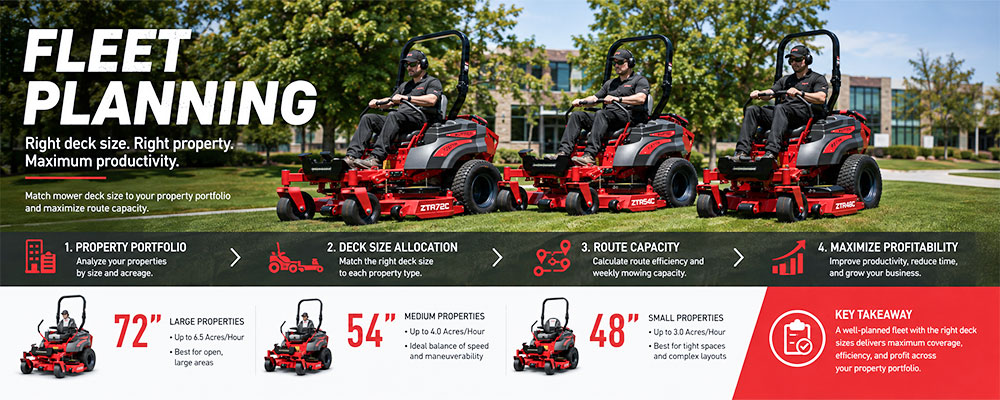
Create a constraint table for every route: narrowest access, trailer usable width and length, ramp rating, tow-vehicle payload and combined mass, tie-down positions and storage. A fleet mix is not workable if the correct mower cannot be transported legally and safely with the rest of the crew's equipment.
Set utilization and backup policy
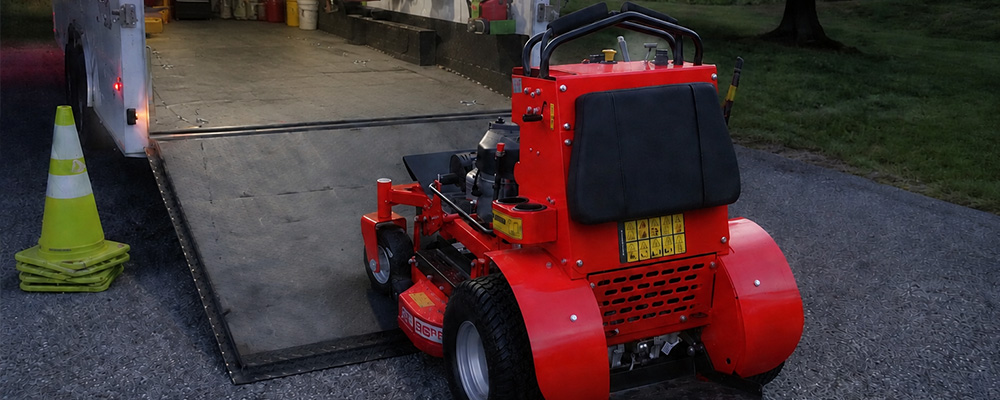
Very high utilization can look efficient but leaves no room for maintenance, weather recovery or breakdowns. Define a target utilization band and backup rule based on contract penalties and service capability. Backup can be a spare unit, cross-route capacity, rental agreement or dealer support. Record which routes have no substitute machine.
Seasonal surge planning
Most landscaping markets have a six-to-eight-week peak where grass growth outpaces the fleet's normal throughput. A crew that handles 70 acres comfortably in June may be underwater in May when growth rates double. Three approaches to bridge the surge without overcapitalizing the fleet year-round:
Rent or short-term lease for peak weeks. A 72-inch zero turn rented for four weeks at $400–$600/week adds $1,600–$2,400 to the season but keeps routes on schedule without a permanent purchase. Compare that to the cost of losing a contract because three properties were consistently cut a day late.
Stagger maintenance into the off-peak. Schedule annual transmission service, deck rebuilds, and major repairs for December–February when machines are under lower demand. A mower in the shop during August costs you; the same machine in the shop during January costs you nothing in lost revenue.
Cross-train crews on the widest machine. During the surge week, assign your most productive operator to the 72-inch and have them run the largest properties back-to-back while the rest of the fleet handles detail work. One wide-deck machine operating at full capacity for eight productive hours can cover 50–60 acres in a day — equivalent to two 54-inch units at normal pace.
The goal is not to own enough mowers for the peak week. The goal is to clear the peak week without deferring work, damaging client relationships, or burning out crews.

Standardize where it helps
Common engines, filters, blades, belts, tires and controls can simplify training and inventory. Over-standardization can create access or productivity problems, so standardize within functional roles. Use commercial zero turn mowers to map available platforms after route requirements are clear.
Maintenance and replacement planning
Schedule service by engine hours and calendar demands, reserve workshop capacity and track downtime causes. Replace machines based on rising cost per productive hour, reliability and route suitability — not age alone. A unit may be mechanically sound but no longer match the company's contracts.
Fleet planning worksheet
Use this worksheet to map each machine role to route requirements, access limits, backup methods and replacement triggers. Review quarterly and before accepting any new contract that changes the route mix.
| Machine Role | Route Segment | Deck Range | Annual Hrs | Peak-Week Hrs | Access Limit | Trailer Pos. | Backup Method | Service Window | TCO Est. | Replace Trigger |
|---|---|---|---|---|---|---|---|---|---|---|
| Narrow-access | Gated estates | 36–48" | ≤48" gate | |||||||
| General purpose | Suburban lawns | 48–54" | ||||||||
| Open acreage | Campuses / parks | 60–72" | ||||||||
| Backup / spare | Any | — | — | — | — | — | N/A | — | — | — |
Fleet cost allocation: track cost per hour, not just cost per machine
A fleet cost-tracking system that only records purchase prices and repair bills misses the relationship that drives replacement decisions. For each machine in the fleet, track at minimum:
| Metric | Why it matters |
|---|---|
| Cost per productive hour (CPH) | Purchase price + fuel + parts + labor + downtime cost ÷ productive hours. When CPH rises 30% above the fleet average, the machine is costing more to run than it earns — regardless of its age. |
| Unscheduled downtime hours per 100 operating hours | Trending upward indicates a machine nearing the end of its reliable service window. A unit with 4+ hours of unscheduled downtime per 100 operating hours is disrupting crew schedules and should trigger a replacement evaluation. |
| Fuel cost per acre | Normalizes efficiency across deck sizes. If a 72-inch burns more fuel per acre than a 60-inch on similar terrain, investigate operator technique or engine tuning before concluding the machine is the problem. |
| Parts cost as a percentage of purchase price | When cumulative parts cost exceeds 40–50% of the original purchase price within a 12-month window, the machine has likely passed its economic replacement point. |
Allocate these metrics to individual machines, not the fleet average. A single high-CPH unit hidden inside a healthy fleet average delays a replacement decision until the machine fails during peak season. Review the numbers quarterly to distinguish between maintenance cost (expected, declining machine) and repair cost (unexpected, failing machine).
Fleet planning benefits
Reduce downtime crises
A 15–20% capacity buffer ensures weather delays and breakdowns do not cascade into missed contracts.
Right-size capital spend
Rent surge units instead of owning peak-week capacity that sits idle for ten months.
Extend machine life
Off-peak maintenance scheduling keeps machines out of the shop during revenue-generating months.
Data-driven replacement
Cost-per-hour tracking replaces guesswork with clear financial signals for fleet refresh timing.
Connection to dealer demand
A contractor's fleet plan becomes useful demand evidence for suppliers. Dealers can aggregate requested deck sizes and replacement dates using the dealer inventory mix framework, while keeping that stocking decision separate from the contractor's operational plan.
Frequently Asked Questions
How many mowers should a landscaping company own?
Divide total weekly acreage by the deck-width productivity for each route type, then add a backup unit for every 3–5 production machines. A crew cutting 200 residential lawns per week might run two 54-inch zero turns plus a backup. The formula is: machines = (weekly acres ÷ acres-per-machine-hour ÷ available hours) + backup units.
When should I replace a commercial mower?
Replace when the cost per productive hour starts climbing — not when the machine breaks for the third time. Track unscheduled downtime, parts cost per 100 hours, and cut-quality complaints. Most commercial operators target 2,000–3,000 hours for primary route machines.
Should I mix deck sizes in a fleet?
Almost always. A uniform fleet simplifies parts and training but forces every machine to fit the smallest gate on the route. A mixed fleet — one 36–48" for narrow access, two 54–60" for general routes, one 72" for open acreage — covers more revenue opportunities with fewer compromises.
What trailer do I need for a commercial mower fleet?
The trailer must carry the heaviest machine, not the average. A ZTR-72C dry weight is 646 kg — add fuel, kit, and spare parts and you are approaching 800 kg per unit. Factor tongue weight, tow vehicle payload, and the combined mass of all crew equipment.
How do I calculate daily route capacity?
Formula: productive acres per day = (deck width in inches ÷ 12) × speed in mph × 5,280 ÷ 43,560 × field efficiency. At 8 mph with a 60-inch deck and 80% field efficiency: (5 × 8 × 5,280 ÷ 43,560) × 0.80 ≈ 3.9 acres per productive hour. Deduct drive time, fueling, trimming, and breaks from available hours before multiplying.
Should I lease or buy my commercial mower fleet?
Buy if you operate year-round, accumulate 400+ hours per machine annually, and have capital available. Lease if your season is under six months or you want predictable monthly costs. A hybrid approach often works: own the primary route machines that run 500+ hours, lease the seasonal surge units that run 200 hours and get returned in November.
Ready to Optimize Your Fleet?
Use the fleet planning worksheet to map your routes, then review KUTTER commercial zero turn mowers to match deck sizes to your portfolio.

Need Fleet Planning Support?
Our commercial team can review your route mix and recommend a deck-size allocation that matches your contracts.
Contact Us
Related Products

CM25
hot selling index

ZTS-50B
hot selling index

LT-36R
hot selling index

LT-42R
hot selling index