
 Español
 العربية
 Francés
 Русский
 Português
 Deutsch
 Italiano
 Polski
 Malay
Malay
 日本語
日本語
 한국어
한국어
 Nederlands
 Indonesia
 български
 Українська
 فارسی
فارسی
 اوردو
اوردو
 тоҷикӣ
 বাংলা
বাংলা






Best 72-Inch Zero Turn Mower 2026: Procurement Scorecard
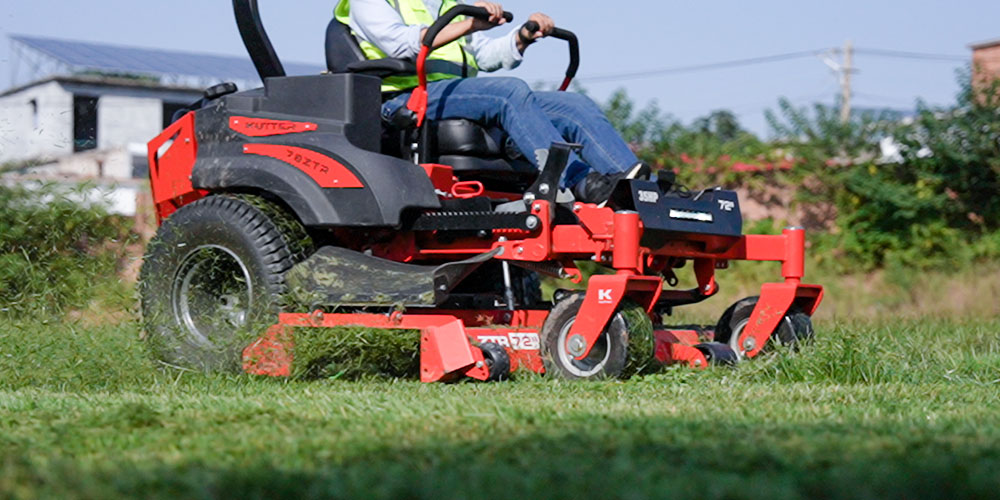
Ask ten fleet managers which is the best 72-inch zero turn mower and you will get eleven answers. The right machine for a 400-acre campus with 20-foot gates is the wrong machine for a route of gated estates with 60-inch entries. This page skips the "top 5" list format and gives you a repeatable scorecard — weight your own criteria, plug in verified specs, and let the numbers pick the winner.
On This Page
There Is No Universal Best — Only Best for Your Route
Ask ten fleet managers which is the best 72-inch zero turn mower and you will get eleven answers. The right machine for a 400-acre campus with 20-foot gates is the wrong machine for a route of gated estates with 60-inch entries. A spec-sheet champion that needs a dealer 200 miles away underperforms a locally-supported second-tier option every time.
This page skips the "top 5" list format and gives you a repeatable scorecard — weight your own criteria, plug in verified specs, and let the numbers pick the winner. The KUTTER ZTR-72C baseline is included for reference.
First Decide Whether 72 Inches Fits
Wide decks favor open acreage and long passes. Measure gates, trailer deck, ramps, storage and narrow landscape transitions. Estimate trimming created by a wider machine. If access forces a crew to carry a second mower, the route-level cost may outweigh the time saved on open turf.
What a 72-Inch Deck Actually Delivers Over 60-Inch
The math is straightforward but easy to misapply. A 72-inch deck provides 20% more cutting width per pass than a 60-inch (72 ÷ 60 = 1.20). At identical ground speed and field efficiency, that translates to roughly 20% more acres per productive hour. On a 9-hour route day with 6.5 productive mowing hours, a 72-inch at 7.5 acres/hour covers 48.8 acres versus 40.6 acres from a 60-inch — an extra 8 acres per day.
But the real-world gain is rarely a clean 20%. Wide decks lose more efficiency on irregular perimeters, require more trimming around obstacles, and add weight that slows transport between properties. On routes with frequent gate entries and tight turns, a 72-inch may deliver only 10–12% more daily output than a 60-inch. Run the math on three of your actual routes — not on an idealized rectangle — before concluding that wider equals faster.
Comparison Scorecard
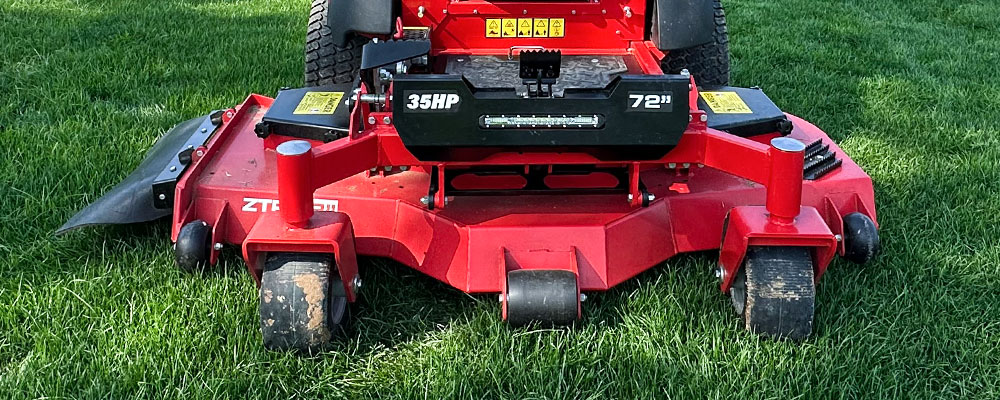
Score each candidate on: usable cutting width and height range; deck construction and service access; engine output and fuel system; hydrostatic transmission class; realistic mowing speed; fuel capacity; machine weight; operator comfort; safety equipment; parts support; warranty terms; certification for the destination market; transport fit; and delivered cost. Weight each category before looking at brands.
KUTTER ZTR-72C Baseline
Current source data lists a 72-inch fabricated, three-blade deck; 1.0–5.0 inch cutting-height range; ZONSEN XP1000EFI 35 HP V-twin engine; 999 cc displacement; 73 L fuel capacity; Hydro-Gear ZT-5400 transmission; up to 14 mph forward speed; and 646 kg weight. Visit the ZTR-72C product page for configuration options and see the ZTR-72C full specifications for the detailed spec sheet.
Deck and Cut Evaluation
Do not award points for width alone. Compare deck depth, baffling, discharge management, blade access, spindle support, deck-lift system and performance in dense or damp grass. Run the same test area at a controlled pace. See stamped vs fabricated mower deck when construction types differ.
Power and Transmission
Engine horsepower should be considered with displacement, torque behavior, cooling, fuel delivery and local service. Transmission selection affects load capacity, heat management, response and repair support. Ask whether the complete drive system is appropriate for machine weight, terrain and annual hours; do not compare component labels without operating context.
Ownership Cost and Support
Build a five-year table with purchase and delivery, fuel, routine parts, scheduled labor, expected wear items, downtime, financing, resale and warranty exclusions. Price comparisons need the same configuration and date. Confirm lead time and local parts channels. The lowest purchase price is not necessarily the lowest cost per productive hour.
Sample TCO: Where the Money Goes Over 2,500 Hours
A commercial 72-inch zero turn accumulating 500 engine hours per year reveals where cost actually accumulates. Over five years and 2,500 hours, a representative breakdown might look like this:
| Cost Category | 5-Year Estimate | Notes |
|---|---|---|
| Purchase price + delivery | $14,000–$19,000 | Varies by brand, EFI vs carb, dealer prep |
| Fuel (gasoline, $3.80/gal, ~1.8 gal/hr) | ~$17,100 | 4,500 gallons over 2,500 hrs |
| Routine parts (filters, belts, blades, fluids) | $2,800–$4,200 | 3–4 blade sets, 8–10 oil changes |
| Scheduled labor (if outsourced) | $2,500–$4,000 | 50-hr intervals at $80–$120/hr shop rate |
| Unscheduled repairs | $1,500–$3,500 | Transmission, spindle, electrical — highly variable |
| Financing cost (if applicable) | $2,000–$3,500 | 60-month note at commercial rates |
| Minus: residual value at 2,500 hrs | ($4,000–$6,000) | Varies sharply by brand reputation |
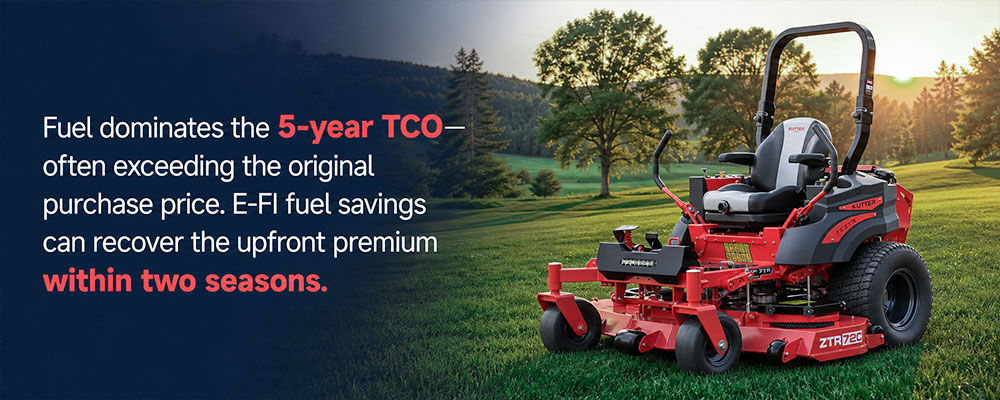
The fuel line alone exceeds the purchase price. This is why EFI — with 10–20% better fuel economy — can offset a $1,200–$1,500 upfront premium within two seasons. A $2,000-cheaper carbureted machine that burns 15% more fuel at $3.80/gallon costs an extra $2,565 in fuel over the same 2,500 hours. Price comparisons that ignore fuel are comparing entry fees, not total cost.
Field-Test Protocol
Use the same operator and representative turf. Log mowing time, trimming time, fuel added, cut defects, discharge behavior, operator fatigue, loading time and any fault. Repeat when possible. A field test converts marketing claims into route-specific evidence and reveals whether a wide deck actually improves crew output.
Select Representative Turf
Choose a test property that matches your typical route conditions — grass type, density, slope, and obstacle count.
Use the Same Operator
Operator skill affects productivity as much as machine spec. Use one experienced operator for all test candidates.
Log All Variables
Record mowing time, trimming time, fuel added, cut defects, discharge behavior, operator fatigue, and loading time.
Repeat and Compare
Run the same test area with each candidate under similar conditions. Compare results against your weighted scorecard.

Decision Scorecard — Fill, Weight, and Rank
| Comparison Vector | Weight (1–5) | ZTR-72C | Option B | Option C |
|---|---|---|---|---|
| Deck construction & gauge | 7-gauge fabricated | |||
| Engine displacement & EFI | 999 cc / 35HP EFI | |||
| Transmission class | ZT-5400 dual | |||
| Transport fit (width × trailer) | 72"/646 kg | |||
| Peak productivity (acres/hr) | ~8.5 @ 75% efficiency | |||
| Dealer distance & parts lead time | — | |||
| Warranty terms | — | |||
| 5-year TCO estimate | per route | — |
The scorecard is the comparison methodology — the winner is the machine with the highest weighted score against your actual route data, not the one with the best brochure. For a deeper look at the wider category: commercial zero-turn mower comparison guide.
When a 72-Inch Zero Turn Is the Wrong Answer
Not every large property needs a 72-inch deck. Four situations where a smaller machine produces better route-level results:
Gated routes with sub-72-inch access. If half your properties have 66-inch gates, a 72-inch mower cannot enter them. A 60-inch unit that clears every gate finishes faster than a 72-inch that sits on the trailer.
Properties with dense obstacles. Landscaping islands, mature trees with exposed roots, and irregular bed edges force a wide deck into constant maneuvering. On obstacle-dense properties, a 60-inch zero turn often matches or exceeds throughput.
Multi-property routes with frequent loading. A 72-inch deck adds 100–150 pounds versus a comparable 60-inch. If the crew loads and unloads six times a day, the extra weight and positioning time can erase the mowing-speed advantage.
First-year operators on slopes. A 72-inch zero turn on a 10-degree slope generates more lateral force than a narrower machine. Operators new to zero-turn handling should master slope technique on a 54–60-inch unit first. See our slope safety checklist for a full assessment protocol.
Frequently Asked Questions
What is the best 72-inch zero turn mower for the money?
Define "for the money." If purchase price is 70% of your decision, take the lowest bid that clears your minimum spec. If 5-year TCO drives the math, weight fuel economy, parts lead time, and residual value above the sticker. The scorecard lets you set weights to match your business — no one else's.
How does the KUTTER ZTR-72C stack up against Toro and John Deere?
Spec-for-spec: 7-gauge fabricated deck, 35HP EFI, ZT-5400 transmission. KUTTER typically positions below equivalently-spec'd Tier-1 flagships on price, which narrows or closes the TCO gap. But a real answer requires verified competitor pricing and your own route data — bench-racing on spec sheets alone is unreliable.
Is a 72-inch zero turn worth the size?
If your access points clear a 72-inch deck: yes — width alone gives roughly 20% more ground per pass than a 60-inch at equal speed (72/60 = 1.2). If the narrowest gate on your route is 66 inches: no. Size the machine to the tightest opening, not the largest lawn.
Should I buy EFI or carbureted for a 72-inch zero turn?
For 72-inch commercial machines accumulating 400+ hours per year, EFI is usually the better financial decision — even with the higher purchase price. At 500 hours annually, a 15% fuel-economy improvement saves roughly 135 gallons per year. Multiply by your local fuel price: at $3.80/gallon, that is $513 per year, recovering a $1,200 EFI premium in about 2.3 seasons.
Conclusion: The Method Picks the Winner
A procurement scorecard with unweighted criteria is a feature checklist, not a decision tool. Assign weight based on your actual routes, fill every cell with verified numbers, and buy the machine that scored — regardless of the logo on the hood.
Shortlist after access and support checks pass. Then compare commercial zero turn mowers against your weighted matrix.

Need Help Building Your Scorecard?
We can walk you through specs, pricing, and dealer options — no pressure, just numbers.
Talk to a Specialist
Related Products
LESU24-130
hot selling index
CS1200
hot selling index


ZTR-48C
hot selling index